


 610-647-4477

Kitchen Backsplash Ideas: How to Pick the Look, Material, and Budget That Fit Your Kitchen
After helping countless homeowners plan their kitchens, we’ve noticed the backsplash is where people either have the most fun or get the most stuck. It’s a small slice of wall with a big job: it protects your drywall from grease and water, it ties your cabinets and countertops together, and it’s often the first thing guests notice. The good news is that choosing one gets much easier once you answer three questions. Do you want it seamless or a statement? How much upkeep are you willing to sign up for? And what’s the real budget? For context, a typical backsplash covers 20 to 40 square feet and runs about $10 to $45 per square foot installed, or roughly $500 to $1,700 total, but the material you pick can swing that by thousands. Here’s how to sort through the options.
Key Takeaways
- A typical kitchen backsplash covers 20 to 40 square feet and costs about $500 to $1,700 installed, or roughly $10 to $45 per square foot.
- Installed prices by material run about $4 to $30 per square foot for peel-and-stick, $7 to $35 for subway tile, $7 to $45 for natural stone tile, $8 to $43 for mosaics, and $35 to $200 for a full slab.
- Cement-based grout needs resealing about every 1 to 2 years, while epoxy grout, glazed ceramic or porcelain, and slab backsplashes need no sealing, and natural stone needs sealing about every 12 to 24 months.
- A standard 4-inch backsplash covers only about a fifth of the roughly 18-inch gap between counter and upper cabinets, which is why designers are moving toward full-height installations.
- You can add a focal point for very little money: a 30-inch range wall tiled 36 inches high is only 7.5 square feet, or about $60 to $320 installed in mosaic.
- One tile maker recommends keeping peel-and-stick at least 8 to 9 inches from a burner and 2 inches from other heat-producing appliances.

Start With Three Questions
Before you fall in love with a tile sample, run through these:
- Seamless or statement? Do you want the backsplash to quietly blend into the countertop and cabinets, or to be the star of the room?
- How much upkeep can you live with? Some materials wipe clean in seconds, and others need sealing, special cleaners, and a little babying.
- What’s the budget, and who’s installing it? A backsplash is small enough that a splurge can be affordable, but installation can cost as much as the tile itself.
Your answers narrow the field fast, and we’ll point to the right materials as we go.
Seamless or Statement: Pick Your Lane First
There are two ways to approach a backsplash, and they lead to very different kitchens.
A seamless look uses the same material as your countertop, or a quiet large-format surface, with few or no visible grout lines. It makes the kitchen feel calm, bigger, and easier to clean.
A statement look uses texture, color, or pattern to create a focal point. It adds personality, and it works best when the cabinets and countertops stay simple.
Either way, think about height. In most kitchens the gap between the countertop and the upper cabinets is roughly 18 inches, so a traditional 4-inch backsplash covers only about a fifth of that wall. That’s a big reason many designers now run the material all the way to the underside of the upper cabinets, and sometimes to the ceiling behind the range.
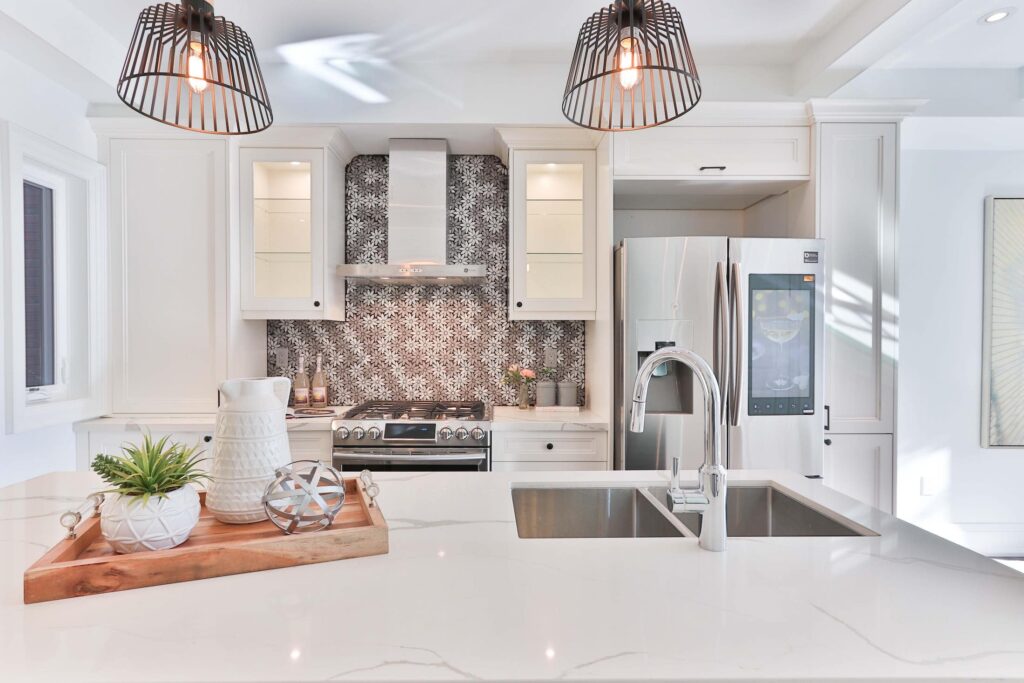
Full-Height Slab: The Seamless Showstopper
A slab backsplash, sometimes called a “countersplash,” continues your countertop material up the wall. Homes & Gardens says full-height slab backsplashes are showing up more and more, and designers say tile that runs to the ceiling creates the same seamless, immersive finish. Slabs can be quartz, quartzite, marble, or large-format porcelain, and the porcelain panels are often just 5 to 6 millimeters thick and cut to fit a specific wall.
- Cost: About $35 to $200 per square foot installed, so a 30-square-foot wall runs roughly $1,050 to $6,000 (HomeGuide).
- Upkeep: Very low, since there are no grout lines to scrub.
- Best for: Modern and transitional kitchens, and anyone who hates cleaning grout.
- Budget version: A 4-inch slab splash with tile or paint above, or a full slab only behind the range with tile on the rest of the wall.
Ceramic Subway Tile: The Classic That Keeps Evolving
Subway tile earned its place for a reason: it’s affordable, durable, and goes with nearly everything. Today’s versions have more personality, with vertical layouts, warm tones, and textured finishes replacing the stark white brick pattern.
- Cost: About $7 to $35 per square foot installed, or $2 to $15 for materials alone (HomeGuide).
- Upkeep: Low, especially with epoxy grout.
- Best for: Almost any style, and almost any budget.
- Tip: Fancier layouts like herringbone cost more in labor, because every cut takes longer.
Zellige and Handmade-Look Tile: Texture With Personality
If you want warmth and character, handmade-look tile is hard to beat. The slight color variation and uneven surface catch light in a way machine-made tile can’t. Designers are still doubling down on zellige, though one designer quoted in Good Housekeeping suggests using it in smaller doses, like near a lower-traffic spot such as a wet bar, and notes that bright, bold patterns can feel chaotic while subtler details tend to age better.
- Upkeep: Medium. The uneven surface and grout joints can hold grease, so epoxy grout is a smart choice.
- Best for: Warm, collected kitchens with wood cabinets and natural finishes.

Natural Stone: Marble, Travertine, and Slate
Nothing looks quite like real stone, and nothing needs more care. Installed cost runs about $7 to $45 per square foot (HomeGuide), and the upkeep matters just as much as the price:
- Marble is soft and porous, and it can stain or etch from acids like lemon juice or vinegar.
- Natural stone typically needs a stone sealer every 12 to 24 months.
- Stone tile should be sealed before it’s grouted, and the joint where the counter meets the backsplash should be flexible silicone caulk, not grout.
Best for: Luxury kitchens and homeowners who love the way stone ages and don’t mind a little maintenance.
Mosaics and Patterned Tile: The Bold Focal Point
Small mosaics and patterned tiles are the easiest way to make a statement, and they cost about $8 to $43 per square foot installed (HomeGuide). The tradeoff is more grout, which means more cleaning. They shine when you keep the rest of the kitchen quiet and use them in a limited area, like the wall behind the range.
Glass Tile: Light and Shine
Glass tile bounces light around, which can brighten a small kitchen, and it’s smooth and easy to wipe. The catch is that it shows water spots and fingerprints, so it suits light-use kitchens better than a busy family cook space.
Budget and DIY Backsplash Ideas
A backsplash is one of the friendliest places to save money, because the area is small and the options are many.
- Peel-and-stick tile: Installed, it costs about $4 to $30 per square foot (HomeGuide), and DIY materials run about $2 to $8 per square foot, per EstimationPro estimates. It’s easy to install and great for rentals, but it doesn’t hold up as well near heat and moisture over time. One tile maker recommends keeping it at least 8 to 9 inches from a burner and 2 inches from other heat-producing appliances, and letting the adhesive set for about 48 hours. Always follow the manufacturer’s instructions and local codes.
- Basic white ceramic subway tile, installed yourself: Tile runs about $1 to $6 per square foot, so 30 square feet costs roughly $30 to $180 in tile, plus thinset, grout, and spacers. This estimates a simple 15-square-foot DIY job at under $150 total.
- Splurge small: Put the pricey material behind the range only, and use something simple on the rest of the wall.
- Hire a pro for the hard stuff: Natural stone, patterns, and slabs are best left to a professional. Labor typically runs $5 to $20 per square foot.
- Plan for extra and for timing: Installers commonly recommend ordering 10% to 15% extra tile for cuts and mistakes, and the backsplash usually goes in after the countertops are set.
Putting together the whole project budget? Our guide to how much it costs to remodel a kitchen shows where a backsplash fits.
Splurge Smart: The Range Wall
If you want a showstopper without a showstopper price, focus on the wall behind the range. A 30-inch range with tile running 36 inches high is just 7.5 square feet. At $8 to $43 per square foot installed for a mosaic, that’s about $60 to $320 for your focal point.
This is also the toughest spot in the kitchen, with heat, grease, and steam. Epoxy grout is the best performer here, since it resists heat, grease, and steam better than cement-based grout and doesn’t need sealing.
How Much Maintenance Is Each Option?
Here’s how the main choices compare on upkeep:
- Lowest: Slab and large-format porcelain, with few or no grout lines.
- Low: Glazed ceramic or porcelain tile with epoxy grout, which needs no sealing.
- Medium: Tile with cement-based grout, which should be resealed about every 1 to 2 years.
- Highest: Natural stone, which needs sealing every 12 to 24 months and care around acids.
Not sure if your backsplash needs resealing? Splash a few drops of water on it. If the surface darkens, it’s time. And for cleaning, skip bleach, acidic cleaners, and metal scrubbing pads, and wipe up grease before it sits for days.

Pairing Your Backsplash With Cabinets, Countertops, and Lighting
A backsplash never stands alone, so choose it with everything around it. Start with the countertop, since the two meet at a visible joint. Our rundown of the best countertops for kitchens covers how materials work together. If you’re mixing cabinet colors, a backsplash can be the bridge, and our tips on two-tone kitchen cabinets include using it as a focal point. And if you’re leaning toward warm woods, creamy whites, and textured tile, it’s worth seeing which choices are shaping kitchens heading into 2027.
A good rule of thumb: let one element lead. If the island is the star of your kitchen, take a look at our kitchen island ideas and keep the backsplash calm. If the backsplash is the star, keep the cabinets and counters simple.
Quick-Reference Numbers
- Typical backsplash size: 20 to 40 square feet
- Typical installed cost: about $500 to 1,700(10 to $45 per square foot)
- Peel-and-stick: $4 to $30 per square foot installed
- Subway tile: $7 to $35 per square foot installed
- Natural stone tile: $7 to $45 per square foot installed
- Mosaic tile: $8 to $43 per square foot installed
- Slab: $35 to $200 per square foot installed
- Professional labor: $5 to $20 per square foot
- Cement grout resealing: about every 1 to 2 years
- Natural stone sealing: about every 12 to 24 months
- Epoxy grout: no sealing needed
- Peel-and-stick clearance (one manufacturer): 8 to 9 inches from a burner, 2 inches from other heat-producing appliances
Choosing a backsplash is one of the most satisfying parts of a kitchen project, and it goes a lot more smoothly when someone helps you see the whole picture. If you’d like that help, schedule an appointment with one of our designers at a showroom in Colmar, Conshohocken, Hatboro, Havertown, or Malvern, or call us at 610-647-4477. You can also play with colors and finishes in our Kitchen Visualizer, browse our gallery for inspiration, and learn what a kitchen designer actually does before your first meeting. When you’re ready, contact us and we’ll get you started.
FAQ
What is the most popular kitchen backsplash right now?
Full-height slab backsplashes, handmade-look zellige tile, and updated subway tile in warm tones and textured finishes are among the most popular choices. Subway tile remains a perennial favorite because it’s affordable and works with nearly every style.
How much does a kitchen backsplash cost?
A typical backsplash covers 20 to 40 square feet and costs about $500 to $1,700 installed, or roughly $10 to $45 per square foot. Peel-and-stick starts around $4 per square foot, while a full slab can run $35 to $200 per square foot.
What is the cheapest backsplash option?
Peel-and-stick tile and basic white ceramic subway tile are the most affordable. Subway tile materials run about $1 to $6 per square foot, so a 30-square-foot backsplash costs roughly $30 to $180 in tile if you install it yourself.
How high should a kitchen backsplash be?
A standard backsplash is 4 inches, but many designers now run it to the underside of the upper cabinets, which is typically about 18 inches above the counter. Some kitchens carry the material all the way to the ceiling behind the range.
Is peel-and-stick backsplash safe behind a stove?
It can be used with care, but it doesn’t hold up as well near heat over time. One tile maker recommends keeping it at least 8 to 9 inches from a burner, so follow the manufacturer’s instructions and local codes.
Do I need to seal my backsplash?
It depends on the material. Natural stone should be sealed about every 12 to 24 months, and cement-based grout about every 1 to 2 years. Glazed ceramic, porcelain, slab, and epoxy grout generally don’t need sealing.
Should the backsplash match the countertop?
It can, and that’s the seamless full-height slab look. But it doesn’t have to. Many designers treat the backsplash as its own design decision, as long as it complements the cabinets and countertops.


